
THE GAGANYAAN TABLE · ARTICLE 01
From sending familiar dishes into orbit to asking what historically evolved food systems can—and cannot—teach us about feeding humans far from Earth.
By Meera Joseph
Published: 29 July 2026 · Version: v1.0 · Status: FINAL LOCKED
What should India feed its astronauts?
It sounds like a question about food.
It may actually be a question about how humans solve problems when every solution creates another constraint.
I began this inquiry expecting to explore whether Indian food traditions might offer useful ideas for human spaceflight. It seemed intuitive: India has centuries of experience with fermentation, drying, preservation, grain-legume combinations, seasonal food systems and foods shaped by geography, scarcity and climate.
But an intuitive question is not necessarily a useful research question.
The first version of mine did not survive very long.
And that turned out to be the interesting part.
The answer was already yes
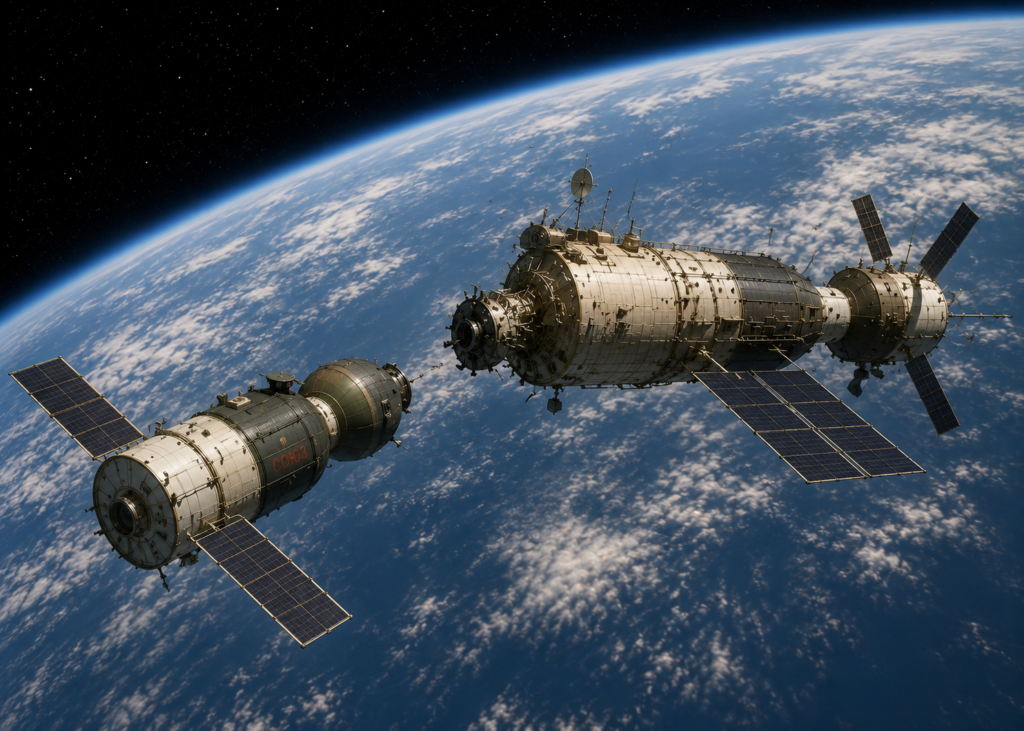
Figure 2. Artist's impression of Soyuz T-11 approaching the Salyut 7 space station in Earth orbit during the April 1984 mission that carried Indian Air Force pilot Rakesh Sharma, the first Indian in space. This contemporary reconstruction was created for editorial purposes and is not a historical photograph.
“Can Indian food go to space?”
Yes.
It already has.
When Rakesh Sharma flew aboard Soyuz T-11 to Salyut 7 in 1984 as part of the Soviet Intercosmos programme, Indian foods specially prepared by the Defence Food Research Laboratory in Mysuru travelled with him. A contemporaneous India Today account from 1984 reported vegetable pulao, aloo chholey and sooji halwa among the dishes prepared for the mission.[1]
Four decades later, Indian space-food development continued. DFRL developed and tested a range of Indian foods around Group Captain Shubhanshu Shukla’s Axiom Mission 4. Precision matters here: according to Shukla’s own account following the mission, three of the specially prepared Indian items — gajar ka halwa, moong dal ka halwa and aamras — were certified for flight. Developed and tested is not the same claim as certified and flown.[2]
So adapting culturally familiar Indian dishes for astronauts is not an unexplored frontier.
That does not make Indian food irrelevant.
It means the original question was too small.
The harder question begins where adaptation ends.
The problem is not getting food into space
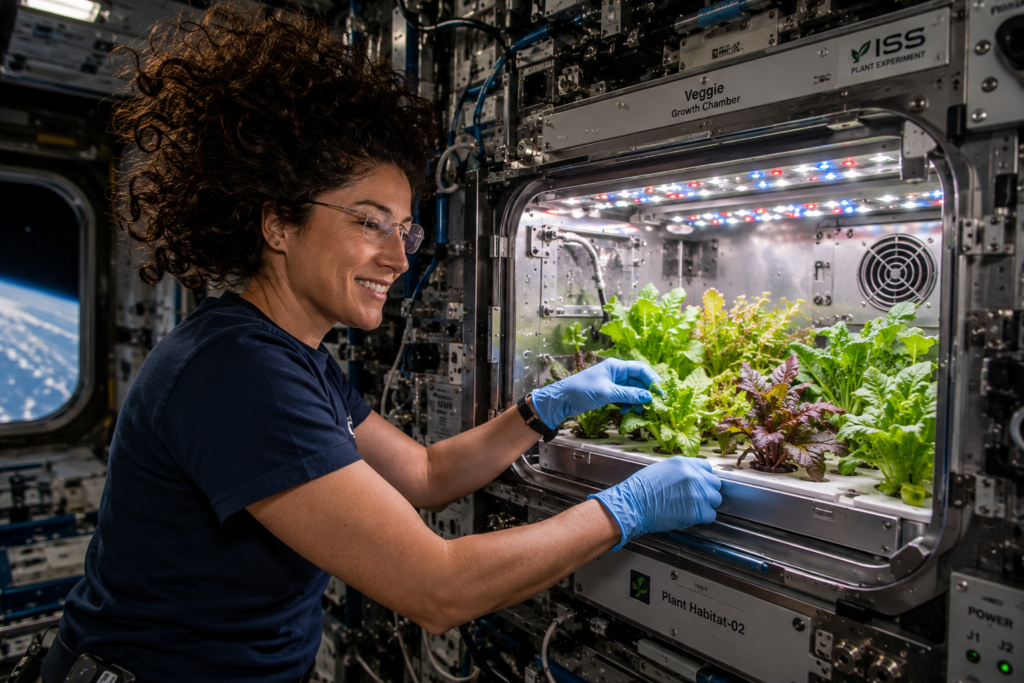
Figure 3. Artist's impression of an astronaut tending leafy greens inside a space-based plant growth chamber. Controlled-environment agriculture aboard orbital platforms is helping researchers understand how fresh foods can be produced during long-duration space missions. This contemporary reconstruction was created for editorial purposes and is not a historical photograph.
NASA states that foods for future long-duration exploration missions may need to remain safe, nutritious and palatable for up to five years, while operating within severe resource constraints.[3]
Why five years? Some Mars mission architectures involve food prepositioned before crew departure — meaning the food a crew opens upon arrival may have been in storage for years before they eat it.
Food can remain microbiologically safe while nutritional quality, sensory acceptability or both deteriorate during prolonged storage. NASA research explicitly treats safety, nutrition and acceptability as separate potential limiting factors on shelf life, and has investigated combinations of processing, packaging and storage technologies to move toward the requirements of long-duration exploration.[4]
NASA researchers investigating extended shelf life moved deliberately toward a hurdle approach — combining multiple stabilisation strategies — after attempts to identify a single technological pathway to five-year shelf life proved unsuccessful.[5]
The challenge is therefore not:
“How do we preserve food?”
It is closer to:
“How do we preserve safety, nutrition, acceptability and useful variety for years while simultaneously controlling mass, volume, water, power, packaging, waste, preparation requirements and crew time?”
NASA describes precisely these interacting resource pressures. Water, power and volume are limited; preparation capability is constrained; and food must still be safe, nutritious and palatable throughout.[6]
There may be no single variable to optimise.
That changes the question completely.
What if we stop starting with dishes?
Once I stopped asking which Indian food should go to space, another possibility appeared.
Humans have repeatedly built food systems under constraint.
Long sea voyages separated crews from fresh supply. Polar expeditions carried food into environments where resupply could become impossible. Seasonal societies preserved abundance for periods when fresh food would disappear. Mobile populations needed foods that were portable, concentrated and durable. Communities developed fermentation, dehydration, salting, smoking, concentration and combinations of these processes long before modern food engineering existed.
This does not mean that traditional knowledge secretly contains the solution to feeding astronauts on Mars. That would be romanticism, not research.
The more defensible question is:
Could historically evolved food systems be examined as hypothesis libraries — not for dishes to copy, but for mechanisms or patterns of constraint management worth testing?
There is intellectual ancestry for thinking this way. Design-by-analogy and related approaches already investigate how mechanisms from one domain may inform solutions in another. TRIZ has long examined contradictions in which improving one system parameter can worsen another.
And Mary Hesse’s foundational work on scientific analogy distinguished not only the similarities between source and target systems — positive analogies — but also the places where they cease to correspond: negative analogies. Hesse argued that these failures carry epistemic content. They help define the limits of an analogy rather than simply making it useless.[7]
So the underlying reasoning is not new.
Our narrower experiment was to apply a constraint-first version of that reasoning to historical food systems and long-duration human spaceflight.
Then came the important part.
We tried to make it fail.
Candidate one: dehydration
Dehydration surfaced almost immediately. It is ancient, effective and intuitively relevant. Removing water inhibits many forms of spoilage, reduces mass and can dramatically extend storage.
It also failed our usefulness test almost immediately — not because dehydration does not work, but because space-food science already knows that it works. Freeze-dried and rehydratable foods have been used in human spaceflight since early programmes, and remain part of contemporary space-food systems.[8]
If an inquiry into historical food systems returns:
“Perhaps astronauts should dehydrate food,”
it has discovered nothing useful.
The analogy is valid. The insight is redundant. That distinction matters.
Candidate two: fermentation
Fermentation looked more promising. Across terrestrial food systems, microbial fermentation can contribute to preservation while also transforming flavour, texture and food chemistry. Could that offer something useful for long-duration missions?
Perhaps — but the analogy weakens substantially once translated into a spacecraft.
Active fermentation introduces questions that terrestrial traditions did not have to solve in the same way: microbial control, containment, gas production, process consistency, crew time, equipment and food-safety management inside a closed habitat.
Pre-fermenting food on Earth avoids many of those problems. But then another question appears: what does the historical analogue contribute beyond what contemporary food science can already formulate and test directly?
The answer is not yet clear.
Fermentation therefore did not emerge from this inquiry as a solution. It survived only as a research question — for example, whether particular pre-fermented food matrices might show useful nutritional or sensory behaviour during prolonged storage compared with appropriate controls. That would require experiments. Analogy alone cannot answer it.
Candidate three: the seductive expedition food
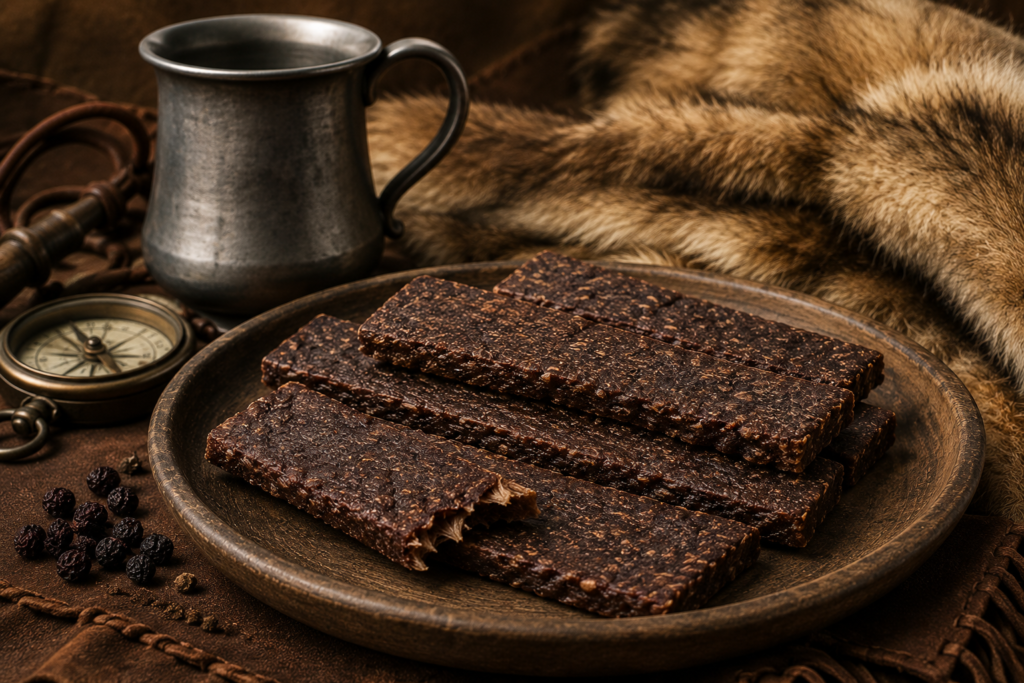
Figure 4. Artist's impression of pemmican, a traditional energy-dense food made from dried meat, rendered fat, and berries. Used for centuries by Indigenous peoples of North America and later adopted by explorers and polar expeditions, pemmican demonstrated many of the characteristics valued in modern space foods, including high energy density, long shelf life, portability, and nutritional resilience. This contemporary reconstruction was created for editorial purposes and is not a historical photograph.
Then came pemmican.
Few analogues are more tempting. Historically associated with Indigenous food traditions, fur-trade travel and later expeditionary use, pemmican combined dried meat and fat into a concentrated, portable food.
A 2021 review documents its history, preparation and association with endurance use across multiple contexts.[9]
The story almost writes itself: high energy density, portability, minimal preparation, historical use under extreme conditions. Mars food?
Not so fast.
Historical usefulness under terrestrial expeditionary conditions is not evidence of multi-year nutritional and sensory stability under spacecraft conditions. Those are different claims.
A food can be an excellent solution to one constraint environment and a poor analogue for another. Contemporary research on pemmican formulations has examined storage characteristics only over weeks under refrigeration — nowhere near the evidence base required for multi-year ambient spaceflight suitability.[10]
The more attractive the story, the easier it is to skip that distinction.
We began calling this risk analogue charisma: the tendency to favour an analogy because its narrative resemblance to the target problem feels compelling before its scientific translation has been tested. That label is our working term, not an established scientific construct.
Pemmican did not survive as a proposed space-food solution. But its failure was useful. It forced a better question: what exactly would have to be demonstrated before a historically successful endurance food became relevant evidence for a long-duration spacecraft food system? Shelf life alone would not be enough. Neither would caloric density. We would need evidence addressing nutritional stability, oxidation, sensory acceptability, safety, packaging, resource requirements and compatibility with the wider mission diet.
The analogy collapsed. The research question improved.
Candidate four: combine several mechanisms
Historical preservation systems rarely used only one mechanism. Drying could coexist with salting. Fermentation altered acidity while producing other preservation effects. Smoking, concentration and environmental storage could interact.
Perhaps the lesson was not one ancestral technology but multiple preservation hurdles working together.
That sounded promising — until we checked what modern space-food research was already doing. NASA had arrived there independently. Its shelf-life programme explicitly investigates combinations of processing, packaging and storage technologies rather than expecting one preservation technique to deliver five-year performance.[5]
So this candidate also collapsed as a novel insight. Historical systems may illustrate the principle well. They did not reveal a principle absent from current space-food research.
Another failure. Another useful boundary.
Then the failures started becoming more interesting than the solutions
By this point, our search had repeatedly failed to uncover a forgotten historical mechanism that modern space-food science had somehow missed. That result could have been disappointing. Instead, it changed the investigation.
Different candidates were failing for different reasons.
Some were redundant: the target field already used the mechanism. Some failed translation: terrestrial functionality did not survive spacecraft conditions. Some failed on evidence: historical success did not establish the modern performance being inferred. Some exposed systems trade-offs: solving one constraint left — or intensified — another. Some fell apart because the target field had independently reached the same principle.
And sometimes the weakest link was causation: a historical practice functioned under a particular constraint, but that did not prove it originally evolved because of that constraint.
These categories emerged from the inquiry itself rather than from a pre-designed taxonomy. They remain provisional.
But something about the pattern mattered. A failed analogy was not necessarily wasted effort. If we could identify why it failed, the failure told us something about the target problem.
This idea itself has intellectual ancestry. Hesse’s negative analogy already established that differences between source and target carry epistemic content rather than simply marking the boundary of the model’s usefulness. More recent work in AI-assisted research methodology has similarly explored preserving structured records of failed hypotheses as durable knowledge rather than discarding them as unproductive attempts.[7][11]
So “failure teaches us things” is not a discovery. The more specific possibility is procedural:
Could systematically examining why an apparently plausible analogue fails help reformulate the original research question?
That remains a hypothesis. But it is exactly what happened here.
Perhaps historical food systems should not be searched for perfect solutions
This produced the most interesting question of the investigation.
What if historical food systems matter not because they solved every constraint, but because humans learned to function while constraints remained unresolved?
That is different. A historical provisioning system did not necessarily maximise shelf life, nutrition, palatability, portability and preparation efficiency simultaneously. It may instead have tolerated compromises. Different foods may have served different functions. Some constraints may have been accepted temporarily. One weakness may have been compensated elsewhere in the wider diet or food system. The system may have managed trade-offs rather than eliminated them.
This is not yet a conclusion about historical food systems as a whole. It is a research direction.
And modern space-food science is already systems-oriented. Researchers explicitly describe nutrition, acceptability, safety, shelf life, reliability, resources and human factors as interacting requirements, and recognise that no current food system fully meets all of them for long-duration deep-space exploration.[12]
So the contribution cannot simply be: “Think of food as a system.” Space researchers already do. The narrower question is more interesting:
When humans historically lived with persistent food-system trade-offs, did they develop patterns of allocation, sequencing, compensation or tolerance that could generate testable hypotheses for extreme modern environments?
Perhaps. Perhaps not. But that question is harder — and better — than asking which traditional dish belongs on Mars.
What did this investigation actually establish?
Very little should be overstated.
Indian foods have already been adapted for human spaceflight. That is documented.
Long-duration exploration creates food-system challenges substantially harder than simply adapting culturally familiar dishes. That is documented.
Historically evolved food systems contain mechanisms that performed real terrestrial functions. That can be documented case by case.
But whether those mechanisms translate usefully to spacecraft conditions cannot be assumed. In our first test, the obvious candidates did not produce a clearly novel transferable solution. Dehydration was already standard. Fermentation raised unresolved translation questions. The expeditionary food analogue’s historical usefulness did not establish the performance required for multi-year spaceflight. Multi-hurdle preservation was already part of NASA’s research direction.
That is the result.
Not: ancient food wisdom solves spaceflight.
Not: Indian cuisine contains a secret Mars technology.
And not: we have invented an entirely new scientific method.
What survived was a better question.
Where India might still matter
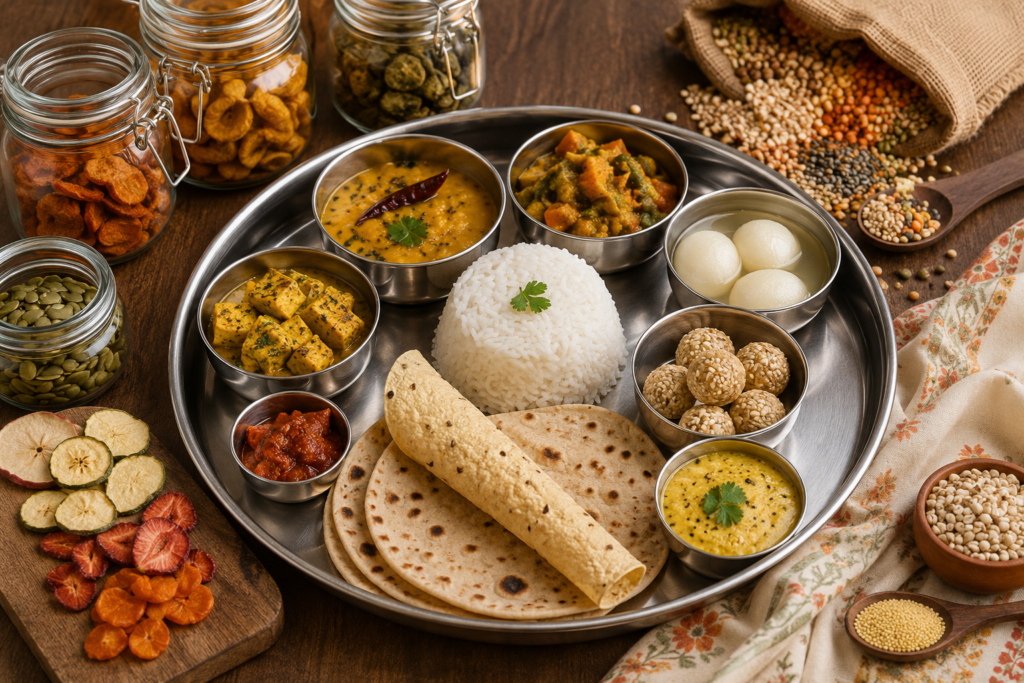
Figure 5. Artist's impression of Indian foods and preservation strategies that could inform future space nutrition. Traditional techniques such as drying, fermentation, roasting, and pickling, together with naturally nutrient-dense grains, pulses, seeds, fruits, and regional foods, offer valuable inspiration for developing shelf-stable, culturally familiar diets for long-duration human spaceflight. This contemporary reconstruction was created for editorial purposes and is not a historical photograph.
The collapse of the original question should not be mistaken for evidence that Indian food systems have little to contribute. It means we have not yet asked enough of them.
India contains food traditions shaped by very different climates, seasonal cycles, preservation constraints, agricultural ecologies, mobility patterns, scarcity histories and cultural expectations. That makes them legitimate candidates for rigorous study. It does not, without comparative evidence, make them uniquely valuable.
The next step would therefore not be to assemble a list of space-worthy Indian foods. It would be to select a historically well-documented food system and reconstruct it carefully: What constraints did people demonstrably face? What did particular practices demonstrably accomplish? Which causal stories are historically supported, and which are assumptions? What trade-offs did the system tolerate? What failed? Which mechanisms survive translation into a precisely defined spaceflight scenario?
And does this process generate a hypothesis that modern food-science search would not have generated anyway?
Zero survivors must remain an acceptable result. Otherwise we are not investigating. We are searching for confirmation.
The question left on the table
We began with:
What Indian foods should go to space?
The evidence pushed back. So the question became:
What can historically evolved food systems teach us about solving spaceflight food constraints?
The obvious analogies pushed back too. Now the question is narrower:
Can studying how human food systems managed persistent, interacting trade-offs generate testable hypotheses for environments where no single food technology can optimise everything at once?
I do not know yet.
That is precisely why it is worth asking.
Perhaps the most useful thing an old food system can offer a future spacecraft is not an old answer, but a different way of seeing the problem.
RESEARCH NOTE
This article is an exploratory, question-led synthesis rather than a systematic review. Statements about the absence of a particular method or approach in the literature mean “not identified in the sources examined for this inquiry” — they do not constitute proof of global novelty or non-existence. Readers with knowledge of relevant prior work are warmly invited to make contact.
NOTES AND SOURCES
[1] Rakesh Sharma flew aboard Soyuz T-11 to Salyut 7, 3 April 1984, as part of the Soviet Intercosmos programme. Indian foods prepared by the Defence Food Research Laboratory, Mysuru, travelled with him. Contemporary report: India Today, 30 April 1984, archived and republished at: “From the India Today archives (1984): Rakesh Sharma: India’s space hero.” India Today, 25 June 2025. Available at: https://www.indiatoday.in/amp/india-today-insight/story/from-the-india-today-archives-1984-rakesh-sharma-indias-space-hero-2746145-2025-06-25
[2] DFRL food development for Axiom Mission 4 and certified flight items. Shubhanshu Shukla’s account distinguishing developed items from certified-and-flown items: “Astronaut Shubhanshu Shukla recalls how DRDO’s aamras, gajar ka halwa reached space.” India Today, 22 July 2026. Available at: https://www.indiatoday.in/science/story/khichdi-failed-why-nasa-cleared-just-three-space-foods-prepared-by-drdo-2953617-2026-07-22
[3] NASA Space Food Systems Laboratory. “Space Food Systems.” NASA, updated 2024. Direct quotation: “Foods on these missions will need to be safe, nutritious, and palatable for up to five years, with very limited resources to ensure the system supports crew health and performance through the challenges of exploration.” Available at: https://www.nasa.gov/directorates/esdmd/hhp/space-food-systems/
[4] Safety, nutrition and acceptability as separate shelf-life limits: NASA Advanced Food Technology programme documentation, including NASA Task Book project records (FY 2025–2026 updates) and NASA Human Research Program Food and Nutrition Risk Strategy (ISLSWG, September 2024, NTRS). Also: NASA Food and Nutrition Technical Brief OCHMO-TB-013 Rev C.
[5] Sirmons TA, Cooper MR, Froio-Blumsack D, Mohr L, Young M, Douglas GL. “Improvement of Shelf Life for Space Food Through a Hurdle Approach.” NASA Technical Reports Server, Document JSC-E-DAA-TN77348, 2020. Available at: https://ntrs.nasa.gov/citations/20200001348. The document states explicitly: “Because previous attempts to determine a singular pathway to a 5-year shelf life for food were unsuccessful, this investigation combines several approaches.”
[6] Interacting resource pressures and mission constraints: NASA. “The Menu for Mars: Designing a Deep Space Food System.” NASA Human Spaceflight. Available at: https://www.nasa.gov/humans-in-space/the-menu-for-mars-designing-a-deep-space-food-system/
[7] Hesse MB. Models and Analogies in Science. Notre Dame, IN: University of Notre Dame Press; 1966. Hesse distinguishes positive analogies (shared features), negative analogies (features present in source but absent in target), and neutral analogies (uncertain status). She argues negative analogies are not failures to be discarded; they carry information about the limits of models and guide scientific advancement.
[8] History of freeze-dried and rehydratable foods in human spaceflight: NASA. “Food on the International Space Station.” NASA History. Available at: https://www.nasa.gov/history/space-station-20th-food-on-iss/
[9] Ngapo TM, Champagne C, Chilian C, Dugan MER, Gariépy S, Vahmani P, Bilodeau P. “Pemmican, an endurance food: Past and present.” Meat Science. 2021;178:108526. doi:10.1016/j.meatsci.2021.108526. PMID: 33945979. Available at: https://pubmed.ncbi.nlm.nih.gov/33945979/
[10] Contemporary pemmican storage research: Kim HJ et al. “Quality and Storage Characteristics of Hanwoo Pemmican by Replacing Canola Oil.” Study examined formulations over approximately two weeks under refrigeration. LWT Food Science and Technology. 2025. PubMed PMID: 41822846. This scope is insufficient to establish multi-year ambient spaceflight suitability.
[11] Wang H. “Negative Knowledge as Failure-aware Shared Memory for AutoResearch.” Preprint / ICML 2026 AI4Research Workshop contribution (not an ICML main-conference paper). arXiv:2606.21024. Available at: https://arxiv.org/abs/2606.21024 This paper argues that structured records of failed research attempts should be maintained as durable knowledge assets alongside positive findings.
[12] Systems-level treatment of space-food constraints: Douglas GL, Wheeler RM, Fritsche RF. “Sustaining Astronauts: Resource Limitations, Technology Needs, and Parallels between Spaceflight Food Systems and those on Earth.” Sustainability. 2021;13(16):9424. doi:10.3390/su13169424. Available at: https://www.mdpi.com/2071-1050/13/16/9424. This paper also constitutes prior art establishing that parallels between terrestrial and spaceflight food systems have been recognised and examined in peer-reviewed literature.
ABOUT THE GAGANYAAN TABLE
The Gaganyaan Table is an independent, question-led editorial inquiry into food, human systems and the challenges of living beyond Earth.

ABOUT THE AUTHOR
Meera Joseph is a food science and nutrition professional, clinical and sports dietitian, and multidisciplinary explorer interested in human-centred challenges in spaceflight. Her work examines questions at the intersection of nutrition, physiology, behaviour, food systems and emerging technologies.
research.thequietmonk.com · The Gaganyaan Table · Article 01