
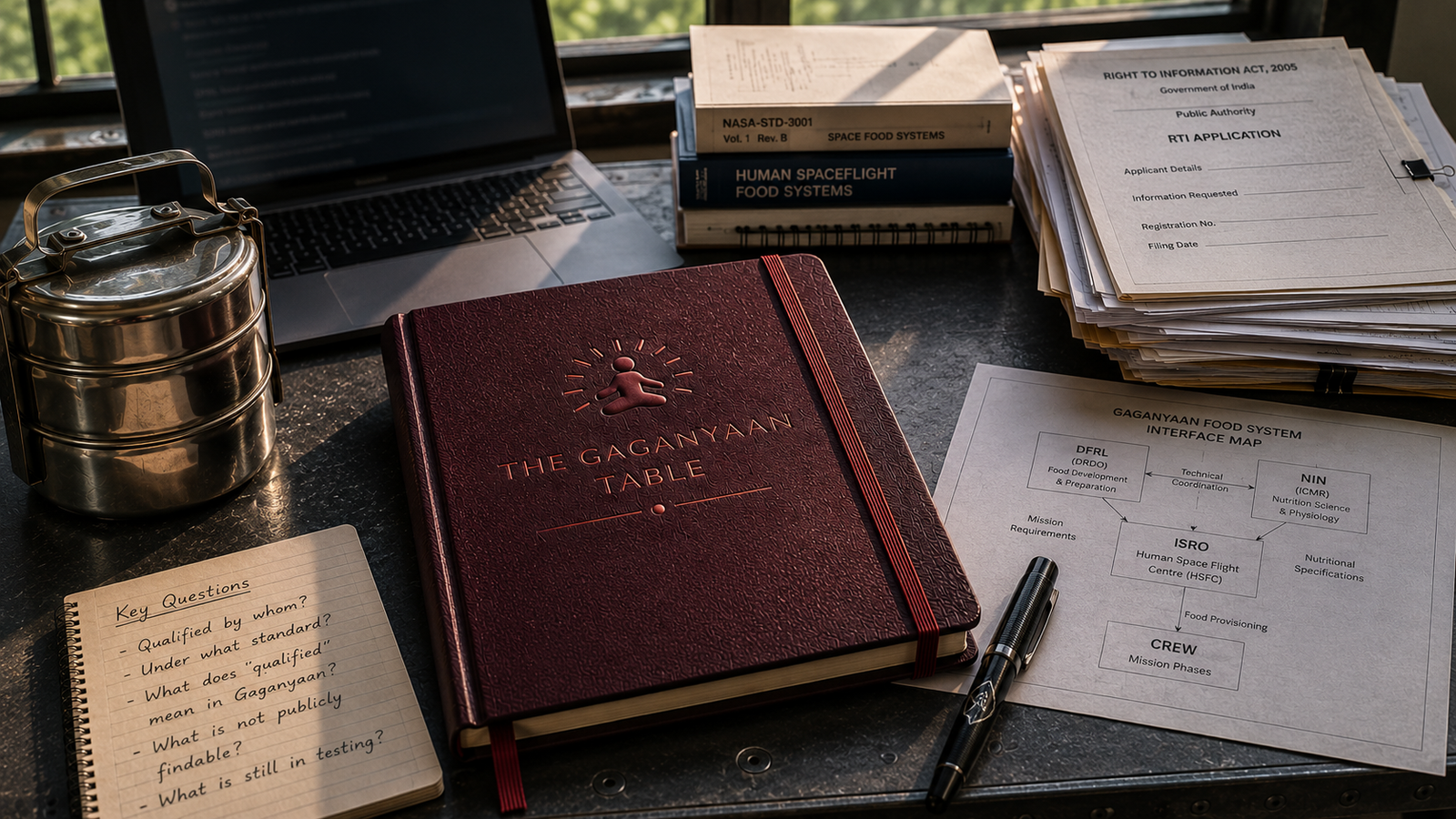
THE GAGANYAAN TABLE · ARTICLE 02
A widely reported claim that a dish “failed” spaceflight qualification led to a public-record investigation into what “qualified” actually means — and how far a citizen can get toward an answer using only what’s public.
By Meera Joseph
Published: 01 September 2026 · Version: v1.0 · Status: FINAL LOCKED
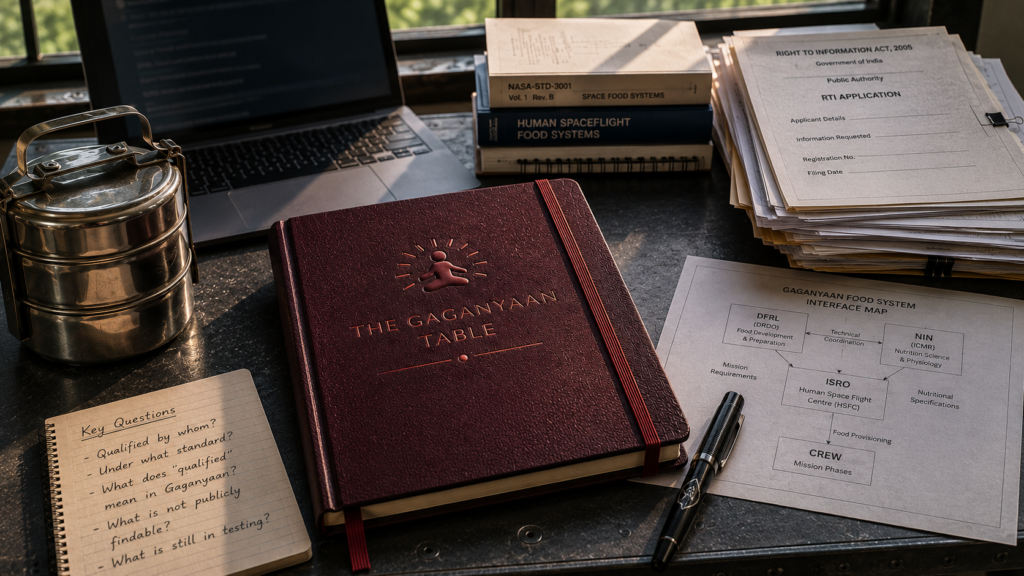
In July 2026, Group Captain Shubhanshu Shukla sat down for a podcast conversation about his weeks aboard the International Space Station, and somewhere in that conversation, he mentioned food. Indian audiences had known for over a year which dishes were meant to travel with him — a menu developed by the Defence Food Research Laboratory (DFRL) that read like a homesick astronaut’s wish list: khichdi, pulao, parathas, vegetable biryani, rajma.[1] What Shukla revealed was that most of it never left the ground. Only three items made it aboard, and all three were desserts: gajar ka halwa, moong dal ka halwa, and a mango preparation called aamras.[2]
Within days, Indian outlets had turned this into a small, wistful national story. “No pulao in space,” one headline offered. Another framed it more bluntly: khichdi had failed.[2] The story had the shape of a minor disappointment — comfort food denied a place in history, for reasons that were never clearly explained.
That framing raises a question the coverage never quite stopped to ask: did khichdi fail?
What Shukla actually said, in his own account, tells a quieter story than the headlines suggest. His own account doesn’t describe a food that was tested and rejected. It describes a food that was still being tested when the clock ran out. DFRL, he explained, had prepared a much wider menu than what ultimately flew — the lab wanted to get as many dishes as possible through the qualification process in time for the mission, with the goal of eventually having them certified. Only three cleared every step before launch. The rest weren’t disqualified so much as unfinished.[2]
That’s a meaningfully different story than “khichdi failed.” A dish that hasn’t completed testing isn’t the same as a dish that was tested and rejected — the first is a status, the second is a verdict. And by Shukla’s own account, what happened to khichdi and pulao was the first, not the second.
Except the story doesn’t stay that clean for long.
Not every outlet that covered Shukla’s remarks told the same version of them. A separate report on the same interview, this one in a regional-language publication, put it differently: only three dishes — gajar ka halwa, moong dal ka halwa, and aamras — succeeded in NASA’s strict safety-and-quality testing. Khichdi and pulao, developed alongside them, were not named among the three.[3]
Two outlets, drawing on the same original interview, arrived at two different pictures of what happened to the same dish. One explicitly frames it as unfinished — a matter of running out of time. The other frames the same outcome around a pass, naming three dishes that succeeded and leaving khichdi and pulao off that list without saying why they aren’t on it. Neither reading, on its own, tells us which framing is closer to what actually happened inside DFRL’s process.
This is usually the point where a piece like this would try to adjudicate the disagreement directly — go back to the source, parse the exact wording, decide who paraphrased more carefully. But that approach runs into a wall almost immediately: Shukla is an astronaut describing a process he experienced from the outside, not the institution that actually ran it. Even a perfectly careful reading of his quote can’t tell us what DFRL’s own internal criteria were, whether “qualification” and “certification” mean different things inside DFRL’s process, or whether the lab itself would use the word “failed” at all. The contradiction isn’t really about what Shukla said. It’s about the fact that nobody outside DFRL seems to know enough about how the lab actually evaluates a dish to settle it.
Which means the real question was never “did khichdi fail.” It’s a question about the system that would have to answer that, if anyone could ask it directly:
Qualified by whom, exactly — and by what standard?
Two institutions, at least two missions
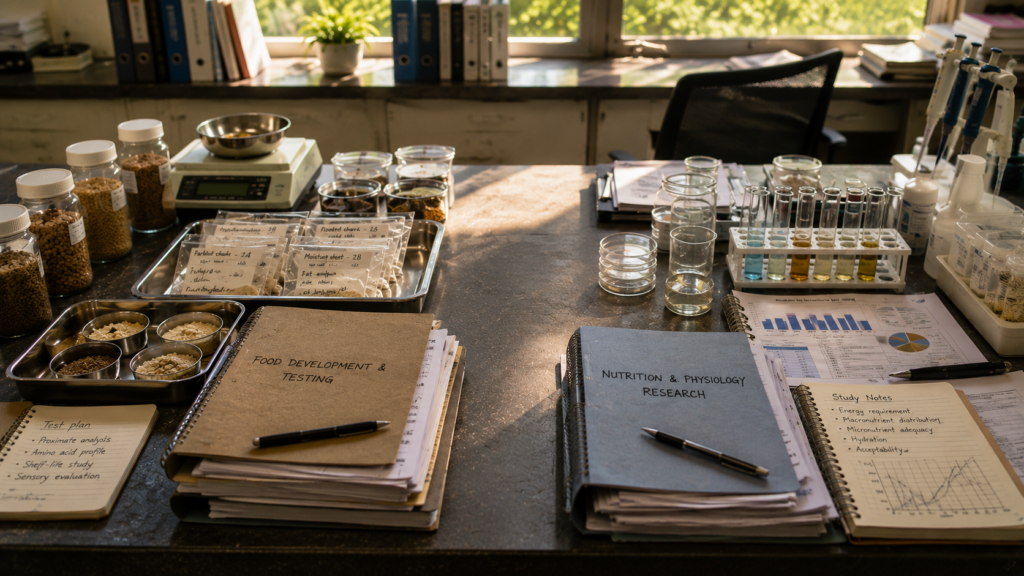
Figure 2. Editorial reconstruction of the distinct food-development and nutrition-research tracks involved in India's emerging human-spaceflight food programme. This contemporary reconstruction is illustrative and does not depict a specific DFRL or NIN facility.
The food itself doesn’t come from one place. DFRL — the Defence Food Research Laboratory, a DRDO lab based in Mysuru — is the body that actually develops and prepares the dishes. But DFRL isn’t the only institution with a hand in whether a dish makes it aboard. The nutrition science and physiological side belongs to a separate body, the National Institute of Nutrition, which signed its own agreement — not with DFRL, but directly with ISRO’s Human Space Flight Centre — to design what astronauts actually eat across each phase of a mission, and to study how the human body handles food in conditions no kitchen ever has to account for.[4]
So “qualified” doesn’t appear to be one decision made by one authority. It looks more like two institutions, each answering to a different part of ISRO, sometimes working together and sometimes not. A dish can be a going concern for one of them and still be an open question for the other.
That matters here for a specific reason. Shukla’s flight — Axiom-4 — wasn’t a Gaganyaan mission at all. It was a private, NASA-brokered trip to the International Space Station, and anything carried aboard the ISS has to meet the standards governing food there, including NASA’s requirements.[3][5] Gaganyaan, India’s own crewed program, is a different animal entirely — an indigenous Indian mission with no ISS docking and no NASA mission sign-off. Khichdi and pulao missing the cut for Axiom-4, in other words, is not obviously the same event as khichdi and pulao missing a hypothetical cut for Gaganyaan. They may have been measured against different rulers.
None of this settles the original question. If anything, it complicates it further: not one “qualification,” but at least two institutions and at least two missions, each with its own version of what qualifying would even mean. Which raises the only question that actually matters if you’re trying to find out what happened to a specific bowl of khichdi:
Where, exactly, is DFRL’s own standard written down — the one that would tell us, in DFRL’s own terms, whether khichdi qualified, and for what?
What the public record does and doesn’t contain
The obvious move is to go find it. NASA publishes one — a detailed standard covering exactly this kind of decision, part of a technical requirement set that also sets thresholds for how a food has to score before it counts as acceptable.[5][6] Japan’s space agency publishes something similar: a named certification process, spelled out step by step, with a public list of which dishes have actually cleared it — including familiar items like yakisoba and Japanese curry, from named manufacturers.[7][8] If DFRL keeps anything comparable, it should be findable the same way — a document, a framework, something with DFRL’s own name on it.
What the public record does contain is evidence that such a process exists in some form. A DRDO official, describing DFRL’s work in 2020, said plainly that space food “will have to finally pass a chain of quality processes,” and that “the tests are specified in the quality control plan, which is well documented.”[13] That’s a meaningfully different finding than “DFRL has no process” — a documented plan is described as existing. What hasn’t surfaced anywhere in the sources examined here is the plan itself, or a public standard defining, in DFRL’s own terms, what qualification or certification actually requires. A process being documented internally and a process being publicly inspectable are not the same thing, and only the first has been confirmed.
It wasn’t found in the sources examined. Searching turns up plenty of coverage of what DFRL has made, but nothing describing how DFRL decides whether something is ready. DFRL’s own stated mission, on the government’s own science portal, runs to three words — design, develop, evaluate — with nothing beneath them. DRDO’s own website has a section reserved for exactly this kind of detail, a page meant to describe what DFRL actually does. It’s empty.
There’s one more route left before giving up on the public record entirely: India’s Right to Information Act, which exists precisely so a citizen can request exactly this kind of document from a government body. Except DRDO isn’t like most government bodies here. It sits in a special category — the Second Schedule of the RTI Act — that exempts it from disclosure altogether, on any subject, with only one narrow exception carved out for allegations of corruption or human rights abuses.[9] The barrier wasn’t the subject of the request. It was the organization’s exempt status itself.
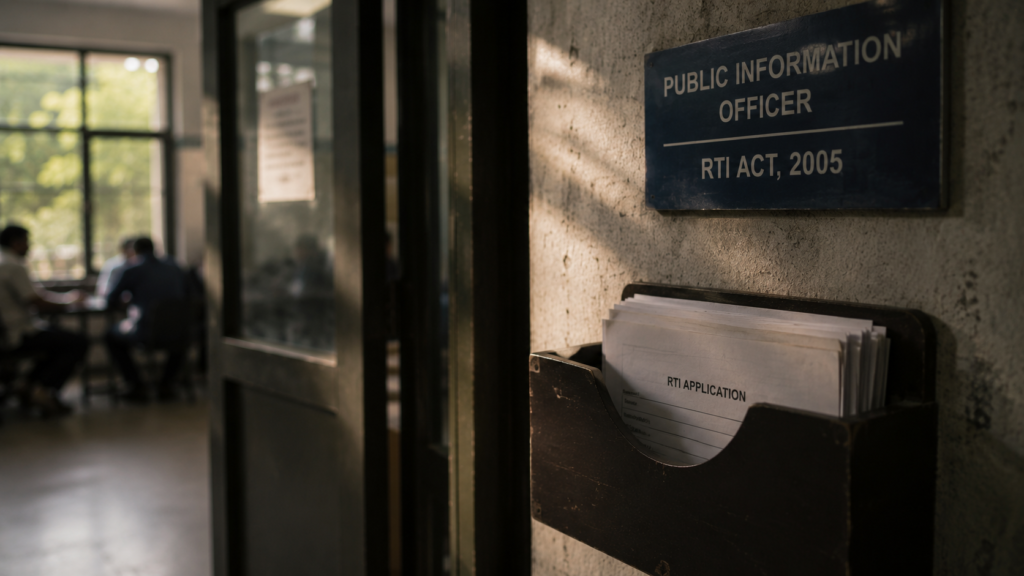
Figure 3. Editorial reconstruction of a public-information office and the documentary boundary encountered during the inquiry. This contemporary reconstruction is illustrative and does not depict a specific government office.
So the verification attempt ends about where it started: no document, and no path that leads to one.
Which leaves one place left to look. Not a document. A person — someone who actually works inside DFRL, who might, at some point, have said something on the record about why.
What one official actually said
As it turns out, someone had — before any of this became a story about khichdi at all.
Months before Shukla’s flight, when the mission itself was still delayed and nothing about the food had made news yet, a DFRL officer named Madhukar spoke to a reporter about what the lab had prepared for the astronaut to carry. He talked about the dishes freely enough — mango nectar, carrot halwa, a few rice items, the human-spaceflight programme director having mentioned some of it at a briefing in Bengaluru. Then, when the conversation reached for something more specific, he stopped himself.
As per the memorandum of understanding between ISRO and DRDO, he said, we are not allowed to give out more details.[1]
That’s the entire explanation, on the record, from someone actually inside the process — not a policy, not press-office boilerplate, but one DFRL official naming the specific document he understood to be limiting what he could say. It doesn’t tell us what’s inside that MoU, or what exactly it restricts, or whether “more details” meant test results, criteria, timelines, or something else entirely. It tells us only that from where Madhukar was standing, there was a line, and he knew exactly which document had drawn it. The quote explains why verification stops here. It does not explain why the arrangement exists.
Two different attempts at the same question — one through the law, one through a person inside the system — arrived at the same answer.
Which still leaves the original question sitting exactly where it started. Not whether khichdi failed. Whether anyone — anyone at all, with anything short of DFRL’s own authorization — currently has a way to find out.
Still on the menu
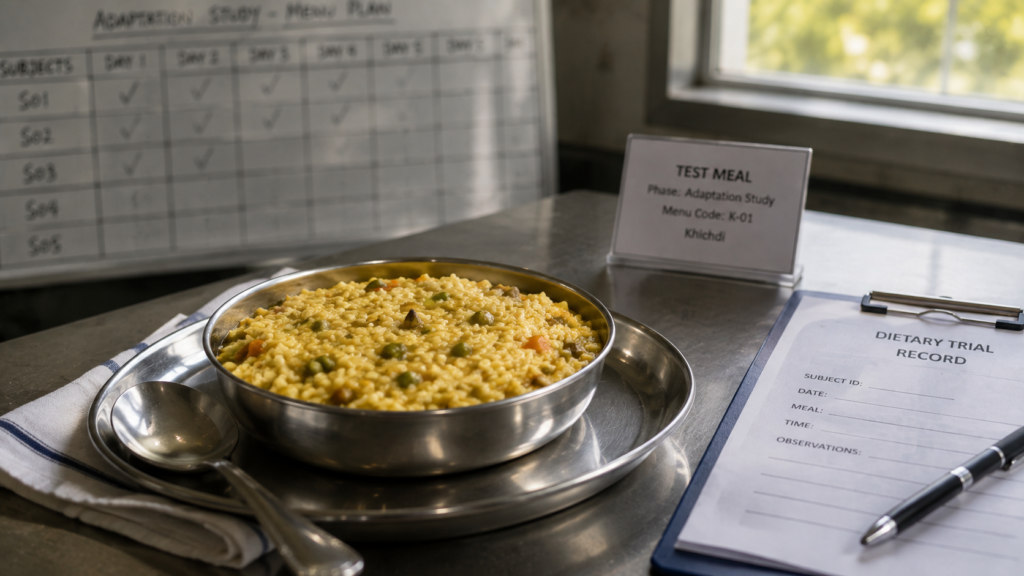
Figure 4. Editorial reconstruction of khichdi in a controlled institutional food-testing setting, reflecting its continuing place in research on food for human spaceflight. This contemporary reconstruction is illustrative and does not depict the Kolkata study itself.
Here is the strange part: khichdi hasn’t disappeared from the picture.
Later this year, a separate institute — the National Institute of Nutrition, the same body that signed its own agreement with ISRO’s Human Space Flight Centre — is due to take part in a study in Kolkata. Eight healthy volunteers are scheduled to spend fourteen days in strict head-down bed rest, a standard way of simulating what microgravity does to the body, eating and carrying out daily activities without ever getting up. Khichdi is on the menu.[10]
So the dish that reportedly didn’t finish qualifying for one mission is still, months later, part of an active line of inquiry for another. That’s not a contradiction of anything said earlier — it’s closer to a continuation. Axiom-4 and Gaganyaan, as established, were never really the same yardstick to begin with, and NIN’s work belongs to the Gaganyaan side of the ledger, not the one khichdi failed to finish in time for.
Which means khichdi’s status right now resists being placed anywhere on the failed-or-cleared axis this article opened with. It isn’t rejected — nothing found in the public record says that it is, and NIN’s planned study places khichdi within an ongoing line of food research. It isn’t approved — nothing found anywhere says so, and DFRL’s own silence, voluntary or not, doesn’t say so either. It’s simply mid-process, in a system whose own recent history offers a reason to think that process itself may not be finished yet: DFRL’s Gaganyaan food work began as one line item inside a single bundled agreement covering seven different defence labs, at a stage when ISRO was still openly inviting outside proposals for “space food and related technologies” as an unsolved problem.[11] India’s first crewed Gaganyaan mission is currently targeted by 2027, with a sequence of uncrewed qualification missions still ahead of it, per the government’s own account to Parliament in August 2026.[12] A finished, formal answer to what “space-qualified” means for this specific program may not exist yet — not because anyone is hiding it, but because the program itself is still being built toward that milestone, not past it.
Where the trail stops
Months after the headlines, khichdi remains part of the plan. That much is on the public record — a menu item in a bed-rest study set to run later this year, in Kolkata, under an institute most of the original coverage never mentioned.
Beyond that, the trail stops. Not at a wall someone built on purpose. At the edge of what DFRL has chosen to say, what the law requires it to say, and what the program itself has gotten around to deciding. Those three edges happen to line up in almost exactly the same place, which is why a citizen with no more than a search engine, the RTI Act, and an afternoon arrives at the same boundary a journalist did, and the same boundary Shukla’s own account gestures at without quite naming.
RESEARCH NOTE
This article is based on Group Captain Shubhanshu Shukla’s public account of the Axiom-4 food-selection process, cross-referenced against multiple independent reports of the same interview. Reporting was checked against public statements from the Defence Food Research Laboratory (DFRL), material published through DRDO channels, and the public parliamentary record relating to Gaganyaan. The article also reviewed publicly available documentation describing how NASA and JAXA publish food-qualification standards and certification processes, as a point of comparison for what is and is not publicly documented. No direct outreach to DFRL was conducted for this article. Statements about the absence of a particular document or standard mean “not located in the sources examined for this inquiry” — they do not constitute proof that no such document exists internally. Readers with knowledge of relevant institutional documentation are warmly invited to make contact.
NOTES AND SOURCES
[1] DFRL officer Madhukar on the ISRO-DRDO memorandum of understanding restricting disclosure of mission food details; pre-launch dish list. Deccan Herald. Available at: https://www.deccanherald.com/india/karnataka/mysuru-s-dfrl-understands-gravity-of-astronauts-food-cravings-3581841
[2] Shubhanshu Shukla’s account of which DRDO-prepared dishes cleared testing for Axiom-4. “Astronaut Shubhanshu Shukla recalls how DRDO’s aamras, gajar ka halwa reached space.” India Today, 22 July 2026. Available at: https://www.indiatoday.in/science/story/khichdi-failed-why-nasa-cleared-just-three-space-foods-prepared-by-drdo-2953617-2026-07-22
[3] Regional-language account of the same interview, attributing the outcome to NASA’s safety-and-quality testing. channeliam.com, 24 July 2026. Available at: https://channeliam.com/2026/07/24/indian-space-food-nasa-approval/
[4] DFRL and National Institute of Nutrition (NIN) operating under separate MoUs with different arms of ISRO. “Hyderabad-based NIN helps plan diet for Gaganyaan astronauts.” Telangana Today. Available at: https://telanganatoday.com/hyderabad-based-nin-helps-plan-diet-for-gaganyaan-astronauts
[5] NASA Space Food Systems Laboratory, responsible for testing and packaging food for ISS delivery under criteria defined in NASA-STD-3001. NASA. Available at: https://www.nasa.gov/directorates/esdmd/hhp/space-food-systems/
[6] NASA-STD-3001, Volume 2: Human Factors, Habitability, and Environmental Health. NASA Technical Standards. Available at: https://standards.nasa.gov/sites/default/files/standards/NASA/D/nasa-std-3001-vol-2-rev-d-signature.pdf
[7] Overview of Japan’s space food certification standard, including reference to the “ISS Food Plan” as the governing document for ISS food supply. JAXA. Available at: https://iss.jaxa.jp/en/spacefood/about/outline/
[8] List of foods certified as Japanese space food, including yakisoba and Japanese curry. JAXA. Available at: https://iss.jaxa.jp/en/spacefood/about/japanese/
[9] DRDO’s placement in the Second Schedule of the RTI Act, 2005, exempting it from disclosure under Section 24(1) except for allegations of corruption or human rights violations. RTI Cell, DRDO, Ministry of Defence, Government of India. Available at: https://www.govtdrdo.com/rti-cell/home.html
[10] NIN’s planned 14-day head-down bed-rest microgravity simulation study in Kolkata, scheduled for November 2026, with khichdi on the study menu. “From Khichdi to Space: How India Is Designing Food for Gaganyaan Astronauts.” Hyderabad Mail. Available at: https://hyderabadmail.com/nin-hyderabad-develops-space-food-for-gaganyaan-astronauts/
[11] DFRL’s Gaganyaan food-development mandate established as one component of a bundled seven-laboratory MoU with ISRO in September 2019, alongside ADRDE, DEBEL, DL Jodhpur, CFEES, DIPAS, and INMAS. “ISRO, DRDO join hands, sign MoUs for Gaganyaan mission.” Deccan Herald, 17 September 2019. Available at: https://www.deccanherald.com/india/isro-drdo-join-hands-sign-mous-for-gaganyaan-mission-762070.html
[12] First crewed Gaganyaan mission targeted by 2027, following a sequence of uncrewed qualification missions. Written reply by Minister of State Dr. Jitendra Singh, Lok Sabha, 5 August 2026. Press Information Bureau, Government of India. Available at: https://www.pib.gov.in/PressReleasePage.aspx?PRID=2294771
[13] DRDO official describing DFRL’s quality control plan for Gaganyaan food as “well documented,” including quality criteria (fragmentation, acceptability, gastro-intestinal compatibility, packaging) and a chain of quality processes prior to space-worthiness screening. “Gaganyaan Unplugged-5: Tasty space food warming up at DFRL Mysuru for India’s manned mission.” Onmanorama, 27 August 2020. Available at: https://www.onmanorama.com/news/india/2020/08/27/gaganyaan-manned-flight-food-warming-dfrl-mysuru.html
ABOUT THE GAGANYAAN TABLE
The Gaganyaan Table is an independent, question-led editorial inquiry into food, human systems and the challenges of living beyond Earth.

ABOUT THE AUTHOR
Meera Joseph is a food science and nutrition professional, clinical and sports dietitian, and multidisciplinary explorer interested in human-centred challenges in spaceflight. Her work examines questions at the intersection of nutrition, physiology, behaviour, food systems and emerging technologies.
research.thequietmonk.com · The Gaganyaan Table · Article 02