
THE GAGANYAAN TABLE · ARTICLE 03
As India prepares for its first crewed missions, the capabilities needed to keep astronauts healthy and functional are being assembled across space, defence, medicine and biotechnology — not housed in one institution.
By Meera Joseph
Published: 07 September 2026 · Version: v1.0 · Status: FINAL LOCKED
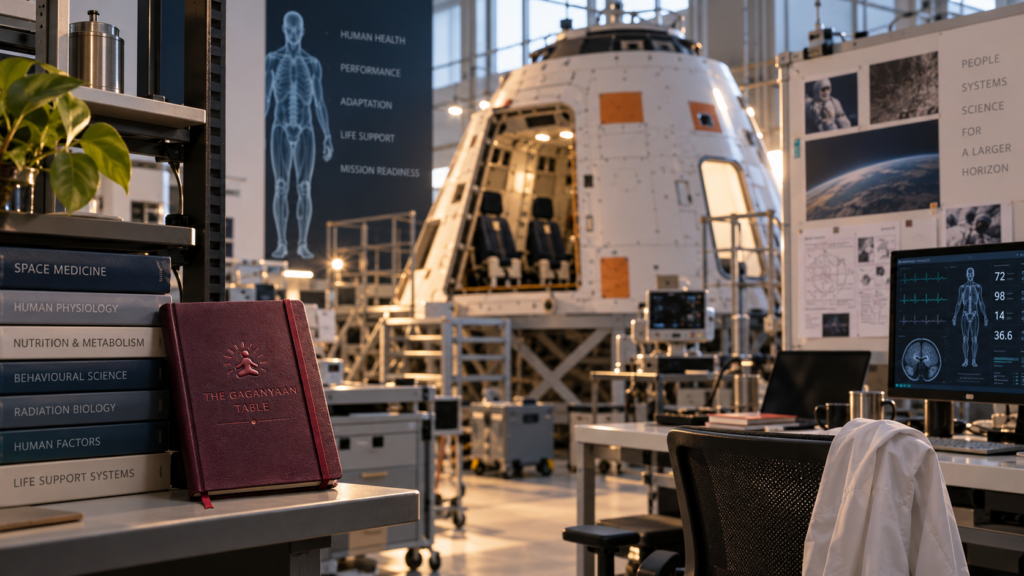
Ask most people what it takes to send a human being into space, and they’ll describe a rocket. Ask them who makes sure that human being survives the trip — eats properly, sleeps, doesn’t lose too much bone density, doesn’t crack under isolation, comes home able to walk — and most people go quiet. Not because the answer is secret. Because nobody has ever had reason to ask them the question.
It’s a strange gap. The rocket gets a name, a launch date, a countdown. The person inside it gets a mission patch and a press conference. The work of keeping that person alive and functional — for the training, for the flight, for the years of preparation before either — belongs to no single visible thing at all.
So: who does that work?
Who already answers this — just not in this vocabulary
The honest answer is that the question, asked exactly that way, doesn’t have a clean address to send it to — but not because nobody’s doing the work. NASA has an entire program built around it, the Human Research Program, organized into elements covering human factors and behavioral performance, health countermeasures, exploration medical capability, and space radiation, sitting inside a Human Health and Performance Directorate that runs to more than nine hundred people.[1] NASA’s own agency-level standard for this work — NASA-STD-3001, Volume 2 — has a title that reads almost like an answer key: Human Factors, Habitability, and Environmental Health.[2]
Japan’s space agency has its own version, organized differently but just as real: two pillars, one covering astronaut health management, the other covering research and development in space medicine, staffed by flight surgeons, biomedical engineers, and specialists in physiology, radiation, and nutrition.[3]
Neither agency calls this “the human layer.” That phrase belongs to nobody. But the work it gestures at — building, staffing, and standardizing the systems that keep a person alive off Earth — very much does. It has names. It has org charts. It has decades of institutional history behind it. The mistake isn’t in noticing that this work matters. It’s in assuming that because the public doesn’t have a word for it, no one is doing it.
It’s worth pausing on why the public doesn’t have that word, because the honest answer isn’t especially mysterious. What tends to travel — through wire services, through general-interest coverage — is a finding: a bone-density number, a specific countermeasure, a study with a result attached. What tends not to travel is the formation of the institution that will eventually produce that finding. A memorandum of understanding is not, by the ordinary rules of what makes something newsworthy, a very interesting event. A study result is. That asymmetry offers a plausible explanation for much of the apparent silence, without needing anything more dramatic — no cover-up, no institutional secrecy, just the ordinary mechanics of what becomes a story and what doesn’t.
Which means the question worth actually pursuing was never who builds this. NASA and JAXA already answer that, in their own vocabulary. The more interesting question — the one that doesn’t yet have a settled answer anywhere — is a different shape entirely:
Is this a thing one organization builds? Or is it something that gets assembled, piece by piece, out of institutions that already existed for other reasons?
A widening set of partnerships
India’s version of this story is still being written, and enough of it is now on the public record to actually look at.
Start with the oldest thread, because it’s easy to miss precisely because it predates the current wave of attention. In 1957, the Indian Air Force established what was then called the School of Aviation Medicine in Bengaluru — training medical officers, evaluating aircrew, running research on the physiological demands of flight. It was renamed the Institute of Aerospace Medicine in 1989, once its work had extended from aircraft into the beginnings of spaceflight relevance. Today it provides aeromedical support directly to Gaganyaan, India’s human spaceflight program — human-centrifuge training, astronaut medical evaluation, the kind of human-factors work that has nothing to do with propulsion and everything to do with whether a body can survive the conditions being asked of it.[4] It has been doing recognizably this kind of work for close to seventy years, under the Indian Air Force, answering to a completely different chain of command than the space program it now serves.
Then, in September 2019, the Indian Space Research Organisation’s Human Space Flight Centre signed a bundle of memoranda of understanding — seven of them, all at once, with seven different Defence Research and Development Organisation laboratories. One covered food. Others covered parachutes, crew health monitoring, radiation protection, fire safety.[5] It was a designed, simultaneous, multi-institution agreement — the kind of thing that happens when an organization decides in advance that several pieces need to move together.
Five years later, in October 2024, a different kind of agreement: the Department of Biotechnology signed its own framework with ISRO, this one aimed at biological experiments for India’s planned space station — bioastronautics, biomanufacturing, work explicitly tied to a facility that won’t exist for years yet.[6]
Then the pace picked up. In April 2025, the Sree Chitra Tirunal Institute for Medical Sciences and Technology signed a cooperation agreement with the Human Space Flight Centre specifically on space medicine research. By November 2025, that had produced something physical: a Center for Space Medicine Research, inaugurated at SCTIMST’s campus. By June 2026, it had produced something else — an implementing agreement launching India’s first postdoctoral fellowship program in bioastronautics.[7]
And in March 2026, the All India Institute of Medical Sciences in New Delhi signed its own framework, naming an unusually wide research scope: physiology, behavioral health, immunology and gut microbiome, neuroscience, nutrition and metabolic health, musculoskeletal atrophy in microgravity, infectious disease.[8]
Lay these out end to end and a shape appears. Not one institution building a human-spaceflight-health apparatus from scratch. Not several institutions ignoring the problem. Something in between: a widening set of partnerships — an Air Force medical institute with roots in the 1950s, a defence-research bundle from 2019, a biotechnology framework from 2024, a medical-research collaboration accelerating hard through 2025 and 2026 — with the four bilateral agreement threads anchored to ISRO/HSFC, while IAM contributes through its own Air Force chain, and all oriented toward the same forward horizon: Gaganyaan, and beyond it, the planned Bharatiya Antariksh Station.
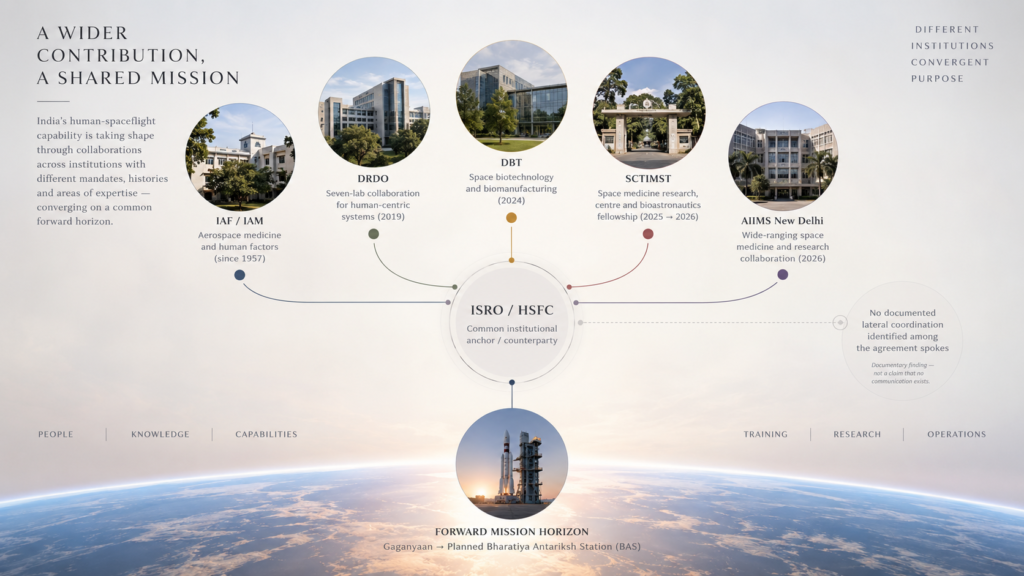
FIGURE 1 — India's documented human-spaceflight institutional topology. Institution buildings shown are artist's impressions created for editorial purposes and are not photographs of the actual facilities. The diagram distinguishes documented institutional relationships from inferred coordination; the absence of a documented lateral link between agreement spokes is a finding about the public record, not a claim that no coordination exists.
What the record doesn’t show
Here’s the part that complicates any tidy version of this story: in the material available on the public record, there’s no documented mechanism connecting these institutions to each other. SCTIMST’s agreement is with HSFC. AIIMS’s agreement is with HSFC. DBT’s agreement is with ISRO directly. IAM answers to the Air Force and supports the program through its own channel. Each spoke reaches the same hub. Nothing found so far shows the spokes reaching each other.
That’s not nothing, and it’s worth being precise about what it does and doesn’t mean. It doesn’t mean these institutions aren’t talking. It means that whatever coordination might exist between them hasn’t surfaced anywhere in the documented record examined for this piece.
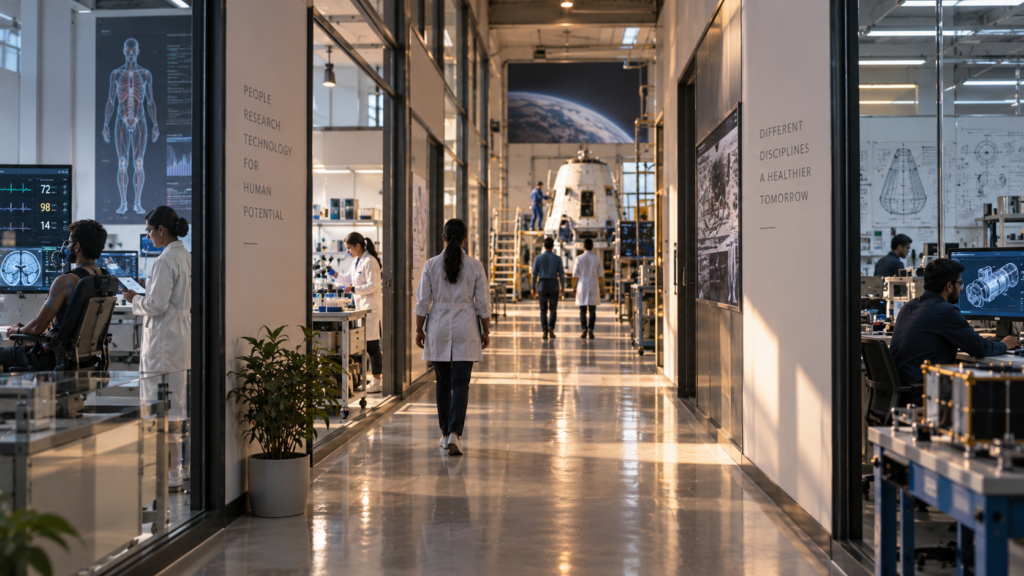
FIGURE 2 — Conceptual editorial reconstruction of a multidisciplinary human-spaceflight research and integration environment. Illustrative rather than documentary; does not depict a specific real facility, institution, or event.
What has surfaced is something else, and it’s more interesting than either silence or scandal. In November 2025, ISRO’s chairman, addressing a joint session with India’s Council for Scientific and Industrial Research, proposed setting up a Joint Steering Committee — explicitly for the purpose of achieving better coordination among public institutions, private industry, and academia working on the space program.[9] It’s the agency’s own leadership identifying a need for better cross-institutional coordination and proposing a mechanism to strengthen it. Whether that mechanism relates to the medicine and biology partnerships specifically, or is aimed at a different layer of the programme, isn’t yet confirmed by anything public.
There’s a useful contrast sitting right inside India’s own record here. The 2019 DRDO bundle does give us an internal precedent for deliberate, simultaneous, multi-institution coordination — HSFC has run that model before. The agreements that followed took a different, sequential form instead. The record examined here doesn’t establish why.

FIGURE 3 — Conceptual editorial reconstruction of separate institutional workstreams examined side by side in this inquiry. Illustrative; does not depict specific real documents, institutions, or an actual coordination meeting.
What it looked like elsewhere, at this stage
None of this, on its own, tells you whether India is doing something unusual. To answer that, it helps to look at how the two most established human-spaceflight programs in the world got their own equivalent architecture — not as it exists today, fully built out, but as it looked at the point equivalent to where India is now.
NASA’s Human Research Program, as it exists today, is not something that simply appeared. In 1999, a NASA directorate at Johnson Space Center was tasked with building what it called a new paradigm — bringing together space medicine, biomedical research, and advanced human-support technology under a new label: Bioastronautics. It expanded through what NASA called extramural participation — including support for outside research through the National Space Biomedical Research Institute.[10] For years, NASA’s human-health research therefore included substantial work carried out through institutions it didn’t own, not unlike the shape India’s own partnerships take now.
It wasn’t until October 2005 — six years later — that the Human Research Program as a formally consolidated structure was established, and even then, that consolidation happened as part of a much larger reorganization of NASA’s exploration strategy following the Columbia disaster, not as a decision driven specifically by the needs of human-health research itself.[10]
Japan’s story starts even more modestly. Before Japan had selected a single astronaut, its space agency — then called NASDA — began by studying NASA’s already-established medical standards rather than building its own from nothing. When the country’s first three astronauts were medically screened in 1983, ahead of their 1985 selection, the actual testing happened inside a university hospital — five days of intensive evaluation, run by civilian medical infrastructure NASDA didn’t own, alongside one dedicated flight surgeon recruited specifically for the task. Japan’s now-established two-pillar space medicine structure grew out of that arrangement over decades, not from a single founding decision.[11]
Read side by side, a pattern holds across all three cases, India included: all three show an early reliance on capability that existed outside a single dedicated space-medicine institution — universities, existing medical infrastructure, institutions built for other purposes that happened to have relevant capability already sitting inside them — and only later, if at all, did anything resembling a unified structure form. On that basis, India’s current arrangement looks less like a gap and more like a stage — one that both NASA and Japan also passed through, in their own way, at their own pace, decades before either had a program a visitor could point to and call finished.
That reading has a real limit, and it’s worth stating plainly rather than letting the comparison do more work than it’s earned. Neither NASA’s nor Japan’s early-stage capability, in the material examined here, appears to have crossed as many separate ministries and armed services as India’s does right now — a defence research organisation, an air force medical institute, a health ministry’s premier hospital, a biotechnology department, all answering to one space agency for one shared goal. Whether that specific breadth is unusual, or whether it simply hasn’t been looked for as carefully in NASA’s or Japan’s own early history, isn’t something this piece can settle.
What’s still unresolved
What’s left, then, isn’t a roster of names and what they build. It’s a structure still finding its own shape, in public, in real time. The recent acceleration is visible in the sequence itself: DBT in 2024, SCTIMST in 2025, AIIMS in 2026, with the SCTIMST partnership already producing a research centre and a bioastronautics fellowship of its own — set against a Joint Steering Committee that’s been proposed but not yet confirmed to cover any of them, and a much older Air Force institute that’s been doing adjacent work since before any of this had a name.
Why India is building it this way — whether it’s a deliberate distributed design, a product of how the country’s ministries are structured, a pragmatic use of expertise that already existed elsewhere, or simply how any young human-spaceflight program looks before it’s had time to consolidate — isn’t something the public record currently answers. Neither is exactly how these institutions coordinate with each other day to day, underneath the agreements that are visible. Neither is what happens to the coordination question ISRO’s own chairman has already identified, as the programme moves toward the Bharatiya Antariksh Station era.
Is India building one human-spaceflight capability — or several institutions that will eventually have to discover they were building it together?
RESEARCH NOTE
This article documents institutional relationships and public statements as they appear in the sources examined for this inquiry. Statements about the absence of a documented coordination mechanism mean “not identified in the material examined for this inquiry” — they do not constitute proof that no such coordination exists. Readers with knowledge of relevant institutional arrangements not reflected here are warmly invited to make contact.
NOTES AND SOURCES
[1] NASA’s Human Research Program is organized into elements covering human factors and behavioral performance, exploration medical capability, human health countermeasures, and space radiation, within a Human Health and Performance Directorate that runs to more than 900 employees. NASA. “Human Health and Performance.” Available at: https://www.nasa.gov/hhp/
[2] NASA’s Spaceflight Human-System Standard, Volume 2 — Human Factors, Habitability, and Environmental Health — is the agency’s own current technical standard governing this area (Version F, effective 14 July 2026, status: Active). NASA Technical Standards System. “NASA-STD-3001 Vol. 2.” Available at: https://standards.nasa.gov/standard/NASA/NASA-STD-3001_VOL_2
[3] JAXA’s space medicine work is organized around two pillars — astronaut health management operations and space-medicine R&D — staffed by flight surgeons, biomedical engineers, and specialists in physiology, psychophysiology, radiation, and nutrition. JAXA Human Spaceflight Technology Directorate. “Space Medicine.” Available at: https://humans-in-space.jaxa.jp/en/biz-lab/med-in-space/
[4] The Institute of Aerospace Medicine traces to the School of Aviation Medicine, established in Bengaluru in 1957, renamed in 1989; it holds a direct, named role in ISRO’s Mission MITRA human-spaceflight crew and ground-team behavioural study (April 2026), with IAM’s director present alongside HSFC’s director at the mission’s inauguration. Indian Society of Aerospace Medicine. “Institute of Aerospace Medicine.” Available at: https://isam.in/MD-Aerospace-Medicine.html. ISRO. “Mission MITRA.” 3 April 2026. Available at: https://www.isro.gov.in/mission_mitra_by_ISRO.html
[5] ISRO’s Human Space Flight Centre signed a bundle of memoranda of understanding with seven Defence Research and Development Organisation laboratories simultaneously, covering food, parachutes, crew health monitoring, radiation protection, and fire safety. Press Information Bureau. “ISRO and DRDO ink MoUs to provide technologies for human centric systems for Human Space Mission.” 17 September 2019. Available at: https://www.pib.gov.in/PressReleasePage.aspx?PRID=1585334
[6] The Department of Biotechnology and ISRO signed a Framework Memorandum of Understanding on Cooperation in Space Biotechnology, explicitly tied to India’s planned space station. The agreement is dated 25 October 2024 on ISRO’s own release. ISRO. “DBT–ISRO signs Framework Memorandum of Understanding on Cooperation in Space Biotechnology.” 25 October 2024. Available at: https://www.isro.gov.in/DBT_ISRO_signs_Framework_Memorandum_of_Understanding_on_Cooperation_in_Space_Biotechnology.html
[7] The Sree Chitra Tirunal Institute for Medical Sciences and Technology signed a cooperation agreement with ISRO’s Human Space Flight Centre on space medicine research on 25 April 2025. SCTIMST’s own admission notice, dated 1 July 2026, confirms a Post-Doctoral Fellowship in Bioastronautics for the August 2026 academic session. The specific 25 June 2026 implementing-agreement date and the November 2025 Centre inauguration date are sourced to independent reporting and have not been independently located on an official SCTIMST/ISRO page; treated as corroborated secondary reporting rather than primary confirmation of those two exact dates. ISRO. “ISRO, DoS and SCTIMST, DST signs Framework Memorandum of Understanding on Cooperation in Space Medicine.” 25 April 2025. Available at: https://www.isro.gov.in/ISRO_EN/ISRO_Space_Medicine.html. SCTIMST. “Admission Notice for Academic Session – August 2026 — Post Doctoral Fellowship (Bioastronautics).” 1 July 2026. Available at: https://www.sctimst.ac.in/News/?id=NTcwXzE3ODQxMDEzNTk%3D. The New Indian Express. “ISRO, SCTIMST to take up research in Bioastronautics.” 18 July 2026. Available at: https://www.newindianexpress.com/india/2026/Jul/18/isro-sctimst-to-take-up-research-in-bioastronautics-2
[8] ISRO and AIIMS New Delhi signed a Framework Memorandum for Cooperation in Space Medicine and Research on 10 March 2026, naming physiology, behavioural health, immunology and gut microbiome, neuroscience, nutrition and metabolic health, musculoskeletal atrophy in microgravity, and infectious disease as research areas. ISRO. “ISRO and AIIMS New Delhi signs Framework Memorandum for Cooperation in Space Medicine and Research.” 10 March 2026. Available at: https://www.isro.gov.in/ISRO_AIIMS_NewDelhi_signs_Framework_Memorandum.html
[9] ISRO Chairman V. Narayanan, addressing a joint CSIR–ISRO session in Bengaluru, proposed setting up a Joint Steering Committee for better coordination among public institutions, private industry, and academia working on the space programme. DD News / News on AIR. “CSIR, ISRO Hold Bengaluru Brainstorming Session to Boost Gaganyaan & Chandrayaan-4 Collaboration.” 17 November 2025. Available at: https://www.newsonair.gov.in/csir-isro-hold-bengaluru-brainstorming-session-to-boost-gaganyaan-chandrayaan-4-collaboration/
[10] NASA’s Bioastronautics initiative began in 1999 at Johnson Space Center, expanding through what NASA calls extramural participation, including the National Space Biomedical Research Institute. The Human Research Program was formally established as a consolidated structure in October 2005, as part of a broader agency-wide reorganization following the Columbia disaster. NASA Technical Reports Server. “Human System Risk Management for Space Flight.” Available at: https://ntrs.nasa.gov/citations/20150004600
[11] JAXA’s precursor agency, NASDA, began by studying NASA’s already-established medical standards; the country’s first three astronauts were medically screened in 1983 ahead of their 1985 selection, with the testing conducted at a university hospital over five days, alongside one dedicated flight surgeon recruited for the task. JAXA Human Spaceflight Technology Directorate. “The History of Medicine in the Space Environment.” Available at: https://humans-in-space.jaxa.jp/en/life/health-in-space/med-health/med-history/
ABOUT THE GAGANYAAN TABLE
The Gaganyaan Table is an independent, question-led editorial inquiry into food, human systems and the challenges of living beyond Earth.

ABOUT THE AUTHOR
Meera Joseph is a food science and nutrition professional, clinical and sports dietitian, and multidisciplinary explorer interested in human-centred challenges in spaceflight. Her work examines questions at the intersection of nutrition, physiology, behaviour, food systems and emerging technologies.
research.thequietmonk.com · The Gaganyaan Table · Article 03